

Translate requirements
Turn subjective impressions into objective parameters. Map “soft” or “strong” to lattice density and topology.
Parametric design. Performance built into structure.
Translate load, feel and weight into parameters. Let form follow performance rather than process constraints.
Every design once had to accommodate the mold. Elegant curves and complex proportions were often compromised by tooling constraints. In subtractive and formative manufacturing, draft angles and uniform wall thickness imposed further limits on design.
Additive manufacturing removes that upfront constraint. No draft angles, no enclosed-cavity restrictions. Design returns to its purpose: a component should take the form its loads require.
The same load can be supported by different forms; the same form can offer different levels of softness. This is DfAM—Design for Additive Manufacturing. Complexity is not the objective; function is. Performance moves from trial and error to calculation.
From an open-ended requirement to a production-ready set of structural parameters.
Turn subjective impressions into objective parameters. Map “soft” or “strong” to lattice density and topology.

Generate form through rules. With our proprietary SuperDesigner, one parameter adjustment creates an entire family of structures.
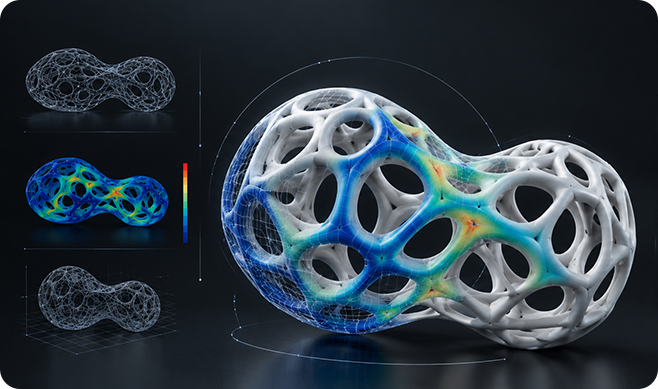
Evaluate before printing. Use mechanical simulation to predict performance and eliminate unworkable options. Calibrate models through physical prototypes, bringing each iteration closer to real-world behavior.
The deeper challenge in DfAM is not modeling software, but coordination between structure and materials. Structure determines the deformation path; material defines the limits of rebound. PollyPolymer develops formulations and structural algorithms on one technical foundation, connecting disciplines traditionally kept apart.
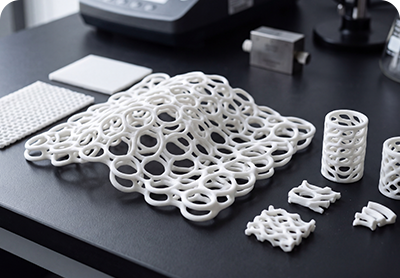
ELASTO elastomers support controlled adjustment of hardness and rebound.
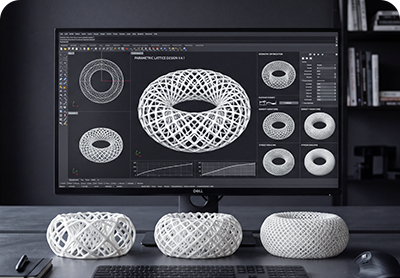
A parametric engine maps loading requirements to lattice topology.

Adjust formulations when structure falls short and lattices when support needs change, within one connected development system.
The deliverable goes beyond a digital model. It is an integrated blueprint connecting design to smart manufacturing.

Complete structural data connected directly to smart cloud factories.

Defined material grades, layer-thickness logic and post-processing routes.

Every structural decision is traceable and verifiable.
Connect with the PollyPolymer DfAM team. Share your target loads, force directions and application needs to develop a measurable structural solution for production.